
 EN
EN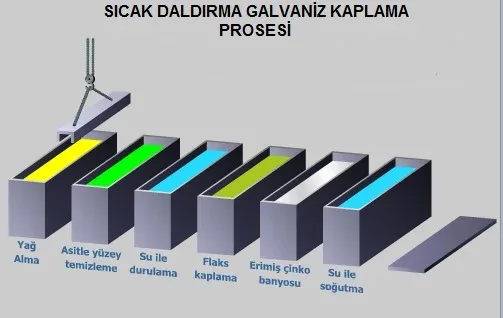
The materials are hung on the racks in accordance with the procedure so as not to strain the operator during immersion. The total weight of the material to be hung on the rack is adjusted according to the capacity of the crane.
1. DEGREASING / RINSING:
One of the most important factors for the materials to be coated is that the surface of the material is clean. By removing unwanted impurities and residues, a very good compatibility and adhesion occurs on the coating surfaces. For this purpose, surface cleaning operations are carried out.
Acid cannot clean chemical substances such as oil and grease on the material. Therefore, in order to prevent the coating from being damaged, substances such as oil and grease on the material enter the degreasing (alkali) bath before entering the acid bath and are cleaned there.
Alkaline cleaning solutions remove the dirt layer. Alkali salts are supplied in powder or crystal form and a solution is prepared by dissolving them in water according to the specification.
If the material is painted, it is not suitable for galvanizing. A rejection label is attached to these materials and they are taken to the unsuitable product area (red area).
2. SURFACE CLEANING WITH ACID:
The material is immersed in the acid pool to remove the rust on the degreased materials and expose the surface. It removes the rust and oxide layers on the steel by chemical means, revealing the clean surfaces underneath. For this process, hydrochloric acid (HCl) solution is used before hot-dip galvanizing coating. Baume measurements are made by checking the concentrations of hydrochloric acid pools at certain periods and the analysis results are recorded in terms of (ºBe) value.
The purpose of acid cleaning is to remove the oxidized layer on the material that forms due to contact with air. The presence of these layers will prevent the reaction of iron with zinc in the zinc bath and those areas will not be coated with zinc. As long as the materials remain in the acid, the acid reaction with the iron continues. After the oxidized layer of the material is cleaned, care must be taken to remove it from the acid bath in time, otherwise corrosion will occur on the material. For this reason, very rusty materials and clean ones are not kept on the same hanger, and the materials are constantly checked by the operators, and the materials whose surface cleaning has been completed are removed from the acid bath.
Since the purpose of surface cleaning with acid is to clean the rusty layer on the material surface, a substance called inhibitor is added to the acid in order to prevent the interaction of the acid with the iron. This does not affect the rust removal rate of the acid and prevents the interaction of the acid on the steel. It reduces the accumulation of iron and zinc in acid. Provides surface smoothness.
3. WASHING:
The purpose of this process after the acid surface cleaning process is not to carry the ferric chloride remaining on the material removed from the acid to the flux bath and thus not to create extra dross in the zinc bath. Therefore, the materials removed from the acid are immersed in the washing bath.
4. FLUX BATH:
The purpose of immersing the material in the flux (ZnCl2.2NH4Cl) bath is to accelerate the reaction between iron and zinc in the zinc bath in order to obtain a better surface. It is immersed in the flux pool to prevent the pure steel surface from oxidizing again before galvanizing. Flux also removes some residue left over from the acid surface cleaning process.
After the materials are immersed in the flux bath, the salts coated on the material burn when immersed in the zinc bath and facilitate the rapid reaction of zinc. In a sense, it can be said that zinc is effective in adhesion to the material surface.
5. DRYING:
The drying process applied to the material after the flux bath is carried out to prevent splashes and the resulting zinc loss, especially for work safety.
6. ZINC COATING:
Iron and steel materials, whose hot-dip galvanizing coating preparation unit has been completed and whose design and chemical composition have been determined to be suitable for galvanization, are coated by immersing them in a zinc bath molten at 450ºC, ensuring the interaction of Fe and Zn.
Immersion times for steel materials in the zinc bath vary depending on the weight and wall thickness of the parts. In order for the iron-zinc reaction to begin, the material must be kept in the molten zinc bath until the temperature of the immersed material reaches the bath temperature. While the materials immersed in the zinc bath are coated, a thin layer of surface cleaning chemicals and oxidation forms on the surface of the zinc bath. Before the materials are removed from the zinc bath, these wastes are cleaned from the pool surface to prevent contact with the material. Thus, the efficiency of coating quality is increased.
Materials whose surface preparation processes are completed enter the zinc bath as a result of the reaction between iron, zinc and iron, causing the dross content in the bath to increase. That's why dross is removed every week. 50 g of aluminum is added to 1 ton of zinc in the zinc bath. Aluminum accelerates the flow in the bath and creates shine in the material. While galvanizing, 10 cm of lead is added to the bottom of the zinc bath to protect it from overheating. While the materials are immersed in the pool, they are immersed without making any ripples as much as possible.
7. COOLING:
The materials taken from the hot-dip galvanizing bath are kept under atmospheric conditions to a certain degree to allow them to cool.
8. FINISHING
The surface of the product is cleaned. They are labeled and packaged according to their size and suitable for shipment.